Overview
Here's a question that sounds modern and isn't: can two bodies attract each other through a fluid, come together, and then stop at a definite distance \(\unicode{x2014}\) held apart by nothing but the fluid's motion? Between 1858 and 1906 four people answered it in four different ways, with water, smoke, pencil and paper. Helmholtz and Kelvin found vortices that neither merge nor separate. Carl Anton Bjerknes built pulsating drums in a water trough and watched floating pellets attracted from afar and pushed away up close, settling at a distance. Hicks found that one spherical vortex can swallow another and keep it inside. And Maxwell built the whole electromagnetic
All four programmes were abandoned by 1900, for reasons we'll go through honestly. But the mechanics they worked out is still correct, because it is just the mechanics of an ideal fluid, and that is exactly the mechanics the AAM needs: in the AAM the
Key Terms
- Ideal (perfect) fluid
- A fluid with no viscosity and, in the classical sense used here, no compressibility: it cannot be sheared by friction and cannot be squeezed. Pressure changes propagate at once, nothing is lost to heat, and a body moving steadily through it at rest feels no drag (d'Alembert). All four authors below assume it.
- Potential flow
- Flow with no local rotation anywhere: every little parcel of fluid may move and deform but does not spin. Such a flow is fixed entirely by its sources, sinks and the shape of the bodies in it. Pumps and pulsating spheres make potential flow; vortices do not.
- Vortex, vortex line, vortex ring
- A region where the fluid parcels do spin. A vortex line is the axis a parcel spins about, threaded through the fluid; Helmholtz showed that in an ideal fluid such lines move with the fluid and never end inside it, so they close on themselves (a ring) or run to a boundary. The circulation \(\Gamma\) (Kelvin's name) is the strength of the spin, and it is conserved: an ideal vortex cannot be created, destroyed, cut or weakened.
- Pulsation
- A body growing and shrinking rhythmically, pushing fluid out and sucking it back. Bjerknes's drums did this at a few beats per second; a gas bubble in a sound field does it at kilohertz.
- Bjerknes force
- The time-averaged force between two pulsating or oscillating bodies in a fluid. Its signature: bodies pulsating in step attract, out of step repel, as the inverse square of the distance \(\unicode{x2014}\) the analogue of electrostatics with the sign reversed.
- Leapfrogging
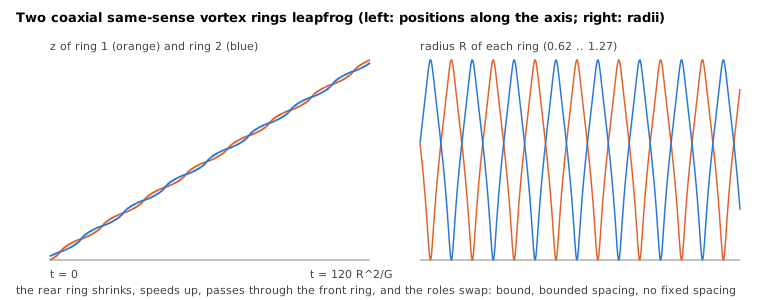
- The motion of two smoke rings travelling the same way along one axis: the rear one shrinks, speeds up, slips through the front one, and the roles swap, for ever. Helmholtz predicted it in 1858; Tait showed it in 1867.
- Idle wheel
- In Maxwell's model, a layer of small particles between neighbouring vortex cells that rolls on both like the idler gear between two cogs, so that adjacent cells can all spin the same way. Their drift is an electric current.
- Natural (Minnaert) frequency
- The frequency at which a bubble or elastic sphere pulsates on its own if poked; smaller bubbles ring higher. A pulsator driven below its natural frequency moves in step with the drive and one driven above moves out of step, which decides the sign of the Bjerknes force between two pulsators of different size.
Setting the Stage: Fluid Mechanics as the Hope for Mechanism
By the 1850s electricity and magnetism had exact laws and no mechanism. Coulomb's and Amp\(\unicode{x00e8}\)re's forces acted across empty
Helmholtz proved three things that sound simple and are not. In an ideal fluid, a vortex line always consists of the same fluid parcels; the strength of a vortex tube is the same all along it and does not change in time; and therefore vortex lines cannot end inside the fluid and vortices cannot be made or unmade by any motion of the fluid itself. He worked out the motion of circular vortex rings and predicted the leapfrog:
"the foremost widens and travels more slowly, the pursuer shrinks and travels faster till finally ... it overtakes the first and penetrates it. Then the same game goes on in the opposite order, so that the rings pass through each other alternately."
\(\unicode{x2014}\) Hermann von Helmholtz (1858)
That is the moment the fluid stopped being a mere medium and started looking like a possible constituent of
The technology was almost nothing: water troughs, rubber drums driven by pistons, smoke boxes with a hole in one side, elliptic-integral tables. The mathematics was potential theory and the beginnings of vector analysis. What the period had, and what we are borrowing, was the habit of asking what pushes on what.
Bjerknes: Pulsating and Oscillating Spheres (1875\(\unicode{x2013}\)1906)
Carl Anton Bjerknes (1825\(\unicode{x2013}\)1903) came to hydrodynamics through Dirichlet's G\(\unicode{x00f6}\)ttingen lectures of 1856\(\unicode{x2013}\)57, which contained a result that haunted him: a sphere moves through a frictionless fluid at constant speed with no resistance at all. If the fluid does not resist steady motion, what does it do to unsteady motion? He spent the years from 1861 to 1875 working it out, published in G\(\unicode{x00f6}\)ttingen in 1876 and then in a run of Comptes Rendus notes from 1877 to 1881. His son Vilhelm, later the founder of modern weather forecasting, assembled the theory in Vorlesungen \(\unicode{x00fc}\)ber hydrodynamische Fernkr\(\unicode{x00e4}\)fte (Leipzig 1900\(\unicode{x2013}\)02) and gave it in English as Fields of Force (Columbia, 1906).
The Physical Picture
A sphere that is expanding pushes fluid outward in all directions; the fluid near it accelerates away, and the pressure there drops below the pressure far away (Bernoulli, in its unsteady form). A second sphere sitting in that outward-accelerating stream is like a body in a gravitational field pointing outward from the first: a body denser than the fluid is pushed against the acceleration, a lighter one with it. Bjerknes called this "dynamic buoyancy". Now let the second sphere pulsate too. If both expand together, each sits in the other's outward surge at the moment it is itself largest, and the net time-averaged push is toward the partner. If one expands while the other contracts, the push is away. The force falls as the inverse square because the acceleration of the radial flow from a pulsating sphere does. Vilhelm's theorem:
"Between bodies pulsating in the same phase there is an apparent attraction; between bodies pulsating in the opposite phase there is an apparent repulsion, the force being proportional to the product of the two intensities of pulsation, and proportional to the inverse square of the distance."
\(\unicode{x2014}\) V. Bjerknes, Fields of Force (1906), p. 32
In the modern form (Crum 1975; Leighton 1994), with \(V_1\), \(V_2\) the instantaneous volumes and \(r\) the distance,
\( F = -\dfrac{\rho}{4\pi}\,\dfrac{\langle \dot V_1 \dot V_2 \rangle}{r^2} \)
negative meaning attraction, the brackets a time average. Two spheres of rest radii \(R_1\), \(R_2\) pulsating at angular frequency \(\omega\) with amplitudes \(\xi_1\), \(\xi_2\) and phase difference \(\phi\) give \(F = 2\pi\rho (R_1 R_2 \omega)^2 \xi_1 \xi_2 \cos\phi / r^2\).
This is Coulomb's law with the sign reversed: like attracts, unlike repels. Bjerknes then did the same for a sphere oscillating to and fro along a line without changing volume, and found the analogue of a magnet, again with the sign reversed: "An oscillating body will act upon a pulsating body as an elementary magnet upon a magnetic pole, but with the law of poles reversed." Kelvin had the oscillating-sphere result first, in 1870, by a different route, as Bjerknes acknowledged.
The Experiments
In 1881 Bjerknes and the nineteen-year-old Vilhelm showed the whole thing at the Paris Exposition internationale d'\(\unicode{x00e9}\)lectricit\(\unicode{x00e9}\), before Helmholtz, Kirchhoff, Kelvin and the Siemens brothers. George Forbes described the apparatus in Nature (24, 18 Aug 1881): a water trough about six inches deep, two "tambours" (drums with india-rubber faces) driven by piston air-cylinders in concordant or discordant phase, and lines of force traced with a paint-brush on a spring.
"if the pulsations are of the same kind ... there is attraction. But if one expands while the other contracts ... there is repulsion. In fact the phenomenon is the opposite of magnetical and electrical phenomena, for here like poles attract, and unlike poles repel."
\(\unicode{x2014}\) George Forbes, Nature (1881)
Light cork bodies were repelled by an oscillating drum and heavy ones attracted, which Bjerknes read as diamagnetism and paramagnetism with the sign reversed.
The Observation That Matters for Us
Buried in the same reports is a case where the force changes sign with distance. Put a small pellet that does not pulsate on its own between two drums beating in step. The pellet is forced to pulsate by the drums' pressure field, and an induced pulsation is out of step with what induces it, so at a distance the pellet is repelled; but a pellet is also a body heavier than water sitting in an accelerating stream, and that effect, the plain dynamic buoyancy of a neutral body, pulls it in. Forbes: the pellet "cannot remain exactly in the centre, but will be repelled to a certain distance, beyond which however there is the usual attraction." The Scientific American Supplement (14 Jan 1882) put it the other way round for a light body: "attracted within a certain radius and repelled when it is placed further off." And Vilhelm gave the general rule for two pulsators with opposite phase but very different amplitudes: "At a distance, they will repel each other, but if they be brought sufficiently near together, they will attract."
So the Bjerknes trough already contained a body attracted from far and pushed away near, sitting at a distance. The mechanism is not a new force. It is two forces of different distance laws, one from the body's own pulsation (phase-dependent, \(1/r^2\) in the amplitude product) and one from its induced response to the other's field (always present, different fall-off), crossing at a radius.
What Incompressibility Does
Whittaker records a result of Leahy (1884): in a compressible medium the Bjerknes signs reverse beyond about a quarter of a wavelength of the pulsation, giving attraction for unlike phases and repulsion for like, still as the inverse square. The reversed-sign analogy to electricity therefore holds only inside a quarter wavelength. This is worth remembering when we ask whether the aether itself is compressible.
Kelvin, Tait, J. J. Thomson, Hicks and Hill: Vortices as Atoms (1867\(\unicode{x2013}\)1898)
In mid-January 1867 Tait showed Kelvin smoke rings in his Edinburgh lecture room, from two boxes with a hole in each. Same-direction coaxial rings leapfrogged as Helmholtz had said. Opposed rings approaching head-on "both expanded and moved more and more slowly, never quite touching." Oblique rings glanced off each other and vibrated. A knife could not cut one. Within a month Kelvin had read "On Vortex Atoms" to the Royal Society of Edinburgh (18 Feb 1867): Helmholtz's theory "inevitably suggests the idea that Helmholtz's rings are the only true atoms."
What made the idea compelling was that the ring had, for free, every property a Lucretian atom was supposed to have and none of the arbitrariness. Permanence: "To generate or to destroy 'Wirbelbewegung' in a perfect fluid can only be an act of creative power." Indivisibility: "a closed line of vortex core is literally indivisible by any action resulting from vortex motion." Elasticity: "this kinetic elasticity of form is perfect elasticity for vortex rings in a perfect liquid." Spectra: "the vortex atom has perfectly definite fundamental modes of vibration," and sodium, with its two yellow lines, "may very probably consist of two approximately equal vortex rings passing through one another like two links in a chain." Kelvin's "On Vortex Motion" (1867, published 1869) supplied the circulation theorem and the thin-ring speed \(U \approx (\Gamma/4\pi R)[\ln(8R/\epsilon) - 1/4]\) for a uniformly rotating core of radius \(\epsilon\).
The Forces Between Vortices, Stated Precisely
This is the part the question needs, so let's be exact about what classical vortex dynamics gives (the sources are Helmholtz 1858, Kelvin 1867\(\unicode{x2013}\)69, J. J. Thomson's Treatise on the Motion of Vortex Rings of 1883, and Tait's observations; the ring runs below are integrations of the thin-core equations made for this paper).
- Two parallel straight vortex lines of the same sense, left free, revolve about their midpoint at angular speed \(\Omega = \Gamma/\pi d^2\), and the spacing \(d\) is conserved. There is no force pulling them to any particular spacing and none pushing them apart; every spacing is a steady state. If instead they are held fixed, each sits in the other's stream and feels the Kutta\(\unicode{x2013}\)Joukowski force \(\rho\Gamma U\) directed away from its partner: held like vortices repel, with \(\rho\Gamma^2/2\pi d\) per unit length. Opposite senses translate together as a pair, spacing conserved; held, they attract.
- Two coaxial rings of the same sense leapfrog. Integrating the thin-core equations (rings of radius 1, core 0.1, circulation 1, starting one radius apart, run to \(t = 120\,R^2/\Gamma\)) gives the rings passing through each other fifteen times, the separation oscillating between \(-1\) and \(+1\) and the radii between 0.62 and 1.27. The pair is bound \(\unicode{x2014}\) bounded spacing for ever \(\unicode{x2014}\) but has no fixed spacing. J. J. Thomson: "if the radius of one vortex ring is increased by the collision the radius of the other will be diminished." Rigorous proofs for the Euler equations arrived only in 2024\(\unicode{x2013}\)25.
- Two coaxial rings of opposite sense, head on, do what Tait saw: approach, expand and slow, the spacing shrinking without limit (in the run, from 3 to 0.28 radii while the radii grow fifty-fold, by which point the thin-ring approximation has long failed, but the trend is the point). No hold-apart.
- A ring near a wall decelerates and swells as it approaches, the image effect negligible beyond about one ring radius.
- No two-ring configuration sits at a fixed finite separation. The only steady bound states J. J. Thomson found were linked rings, which "are capable of steady motion, and that this steady motion is stable," lying on a common anchor-ring surface and needing equal strengths; and his famous result that up to six parallel vortices equally spaced round a circle are stable while seven are not ("six is the greatest number of vortices which can be arranged at equal intervals round the circumference").
J. J. Thomson also worked out what vortex atoms do as a gas: a ring approaching another "begins to expand" and "will crawl back on rebounding"; their pressure obeys Boyle's law with a small correction; and, fatally, "the mean radius of the vortex atoms is a function of the temperature," so a vortex atom has no fixed size. Osborne Reynolds pointed out in 1883 that the mean vortex speed would then fall with temperature, against the kinetic theory: "the verdict must be against the vortex atom theory."
Hicks and Hill
William Mitchinson Hicks took the programme furthest. His hollow vortices (Phil. Trans. 1884) replaced the rotating core by a void, giving the thin-ring constant \(1/2\) in place of Kelvin's \(1/4\); Kelvin wrote to FitzGerald that Hicks's work "will be the beginning of the vortex theory of ether and matter, if it is ever to be a theory." Hicks also gave the first vortex-sponge aether (1885), and, most relevant here, from 1879 he proposed that hollow vortex atoms pulsating in the aether attract by an inverse-square law \(\unicode{x2014}\) Bjerknes's force arriving from the vortex side, with the caveat that the attraction holds only if the pulsations are independent of the energy, and that the same law yields "negative" matter repelling ordinary matter. Hill's exact spherical vortex (Phil. Trans. A 1894: azimuthal vorticity \(\propto r\sin\theta\) inside a sphere, potential flow outside) gave a vortex blob whose size is fixed by its circulation and speed, not by a wall; and Hicks remarked in 1895 that one Hill vortex "might swallow up another and retain it inside in an equilibrium state" \(\unicode{x2014}\) "another mode of chemical combination."
Maxwell: A Medium of Molecular Vortices (1861\(\unicode{x2013}\)62)
"On Physical Lines of Force" appeared in four parts in the Philosophical Magazine: Part I on magnetic phenomena (March 1861), Part II on electric currents (April\(\unicode{x2013}\)May 1861), Part III on statical electricity (January 1862) and Part IV on the action of magnetism on polarized light (1862). Daniel Siegel's Innovation in Maxwell's Electromagnetic Theory (Cambridge, 1991) is the book to read on it. His central claim is that the vortex model was for Maxwell a realistic physical hypothesis, not an illustration, taken up after William Thomson judged it time to "go beyond mere analogy," and that both the displacement current and the electromagnetic theory of light came out of the mechanics, not out of the equations.
The Mechanics, in Maxwell's Words
The medium is filled with "vortices or eddies ... having their axes in directions parallel to the lines of force," and "Every vortex is essentially dipolar." A spinning cell is flattened by its own centrifugal force, so it presses outward sideways and pulls inward along its axis:
"the stress in the axis of a line of magnetic force is a tension, like that of a rope"
\(\unicode{x2014}\) James Clerk Maxwell, "On Physical Lines of Force," Part I (1861)
The magnetic state is "a pressure greater in the equatorial than in the axial direction," attributed to "the centrifugal force of vortices or eddies." Part I gives the difference of the pressures across and along as \(p_1 - p_2 = \tfrac{1}{4\pi}\mu v^2\), with \(\mu\) proportional to the medium's density and \(v\) the circumferential speed of the vortex. In Gaussian units this is the familiar \(B^2/8\pi\) of tension along and of excess pressure across, and in the fluid's own units it is simply \(\tfrac12\rho v^2\), the kinetic energy density of the vortex's rim. From the stresses the magnetic forces follow: "whenever the lines of force pass from one pole to another, there is attraction between those poles"; "where the lines of force from the poles avoid each other and are dispersed into space, the poles repel each other"; parallel currents attract "with a force inversely as the distance."
Adjacent vortices spinning the same way would rub the wrong way at their touching surfaces, so Part II interposes "a layer of particles, acting as idle wheels, ... between each vortex and the next, so that each vortex has a tendency to make the neighbouring vortices revolve in the same direction." The drift of these particles is the electric current; their rolling without drift transmits rotation. Maxwell was candid that this "may appear somewhat awkward" and "I do not bring it forward as a mode of connexion existing in nature"; the hypothesis is "provisional and temporary." In Part III the cells are given elasticity, so that an electromotive force displaces the particles against a spring: that displacement, and its rate of change, is the displacement current. The speed of transverse waves in the elastic vortex medium came out at 193,088 miles per second against Fizeau's 195,647, and Maxwell wrote the sentence that founded electromagnetic optics: "we can scarcely avoid the inference that light consists in the transverse undulations of the same medium which is the cause of electric and magnetic phenomena."
What the Stresses Say About Two Vortex Tubes
Two like-sense tubes side by side are two parallel bundles of lines of force: the sideways pressure pushes them apart, which is why like poles repel. Two opposite-sense tubes side by side have their fields cancel between them, the pressure drops in the gap, and they are pushed together. Two like-sense tubes end to end are one line of force: the tension pulls them together. These are the signs of bar magnets, as the model was built to give.
Note two things. First, the side-by-side signs are the same as the Kutta\(\unicode{x2013}\)Joukowski signs for held line vortices in an ideal fluid (like repel, opposite attract), so Maxwell's stress tensor agrees with plain hydrodynamics there. Second, the end-to-end tension is something point vortices on one line cannot show at all; it is a property of a finite cell under stress. And the hold-apart in Maxwell's medium is contact: the cells are packed in a honeycomb with the idle-wheel layer between them, and they yield elastically. Attraction along the axis by tension, hold-apart by the elastic cell: the shape we are after, at the price of an elastic, which is to say compressible, medium.
Contemporary Interpretation
Each programme was taken seriously by the first rank for about a decade and then let go.
Bjerknes was praised for prediction: Forbes wrote that "every result which is thus shown by experiment had been previously predicted by Prof. Bjerknes." Lorentz still cited "the experiments of Prof. Bjerknes in Christiania on transmitted hydrodynamic forces and of his imitation of electrical phenomena with pulsating spheres" in his 1902 Nobel lecture. But the reversed sign meant the fluid could imitate electricity only as a mirror image, and Leahy's result meant the imitation needed strict incompressibility. Bjerknes's own goal of extending the analogy to Maxwell's full theory was never reached, and the Dictionary of Scientific Biography closes the account with "today more a fascinating analogy than a basic physical theory."
The vortex atom drew some sixty papers from about twenty-five authors between 1870 and 1890 (Kragh 2002). Its reception turned on two technical questions, stability and the explanation of gravity and magnetism, and both went against it. Kelvin's doubts date from about 1883; by 1887 he had concluded the ring is "essentially unstable," a judgement he published only in a 1905 footnote: "After many years of failure to prove that the motion in the ordinary Helmholtz circular ring is stable, I came to the conclusion that it is essentially unstable, and that its fate must be to become dissipated." To Silas Holman in 1898: "With great regret I abandon the idea that a mere configuration of motion suffices." Larmor dropped vortex atoms for electrons in 1894; Hicks persisted another decade.
Maxwell himself retreated from the vortex mechanism almost at once. His 1865 "Dynamical Theory" is, as he told Tait in 1867, "built on Lagrange's Dynamical Equations and is not wise about vortices." In the Treatise (1873) the model is "evidently of a provisional kind," "no more than ... a demonstration that mechanism may be imagined capable of producing a connexion mechanically equivalent to the actual connexion." Yet in the same place he kept the core: "I think we have good evidence for the opinion that some phenomenon of rotation is going on in the magnetic field," and "Magnetic force is the effect of the centrifugal force of the vortices." Kelvin never made the transition: in the 1884 Baltimore Lectures, "I can never satisfy myself until I can make a mechanical model of a thing," and he could not make one of Maxwell's theory of light. Hertz, who confirmed the waves in 1887\(\unicode{x2013}\)88, cut the knot the other way: "Maxwell's theory is Maxwell's system of equations."
The Conventional Understanding, Then and Now
The standard narrative is tidy. Vortex atoms were a brilliant wrong turn, killed by instability and by the
The modern bubble literature, however, has gone on quietly doing Bjerknes's physics with better instruments, and it has reached exactly the point that matters here. Crum (1975) and Leighton (1994) give the standard force. Doinikov and Zavtrak (1995) showed that when the mutual coupling of two bubbles is kept, "attraction can change to repulsion at small distances comparable to bubble radii," so that "two bubbles can form a stable bound pair with a fixed separation distance" (Doinikov et al. 2016). Ida (2003) traced the reversal to a second transition frequency of the smaller bubble; Pelekasis and co-workers (2004) found pairs holding a constant average distance; Lanoy et al. (2015) measured attraction at 14 kHz and repulsion at 19 kHz between bubbles of natural frequencies 15 and 25 kHz, confirming the classical sign rule that a drive between the two natural frequencies repels and a drive outside both attracts. None of this is new physics; it is the 1881 pellet, with the induced pulsation now computed instead of observed.
Vortex dynamics likewise became a field of its own (Moffatt 2006 traces the "legacy of Helmholtz and Kelvin"), and its verdict on Kelvin's atoms is now firm: "all but the very simplest three-dimensional vortex structures are dynamically unstable." The two-ring leapfrog, interestingly, was proved rigorously for the Euler equations only in 2024\(\unicode{x2013}\)25.
Critical Analysis
Where did each programme go beyond its data, and what was quietly assumed?
Bjerknes. The theory is exact for an ideal incompressible fluid and the experiments confirm it; the overreach was the hope that electricity is this. The reversed sign was not a detail to be fixed later but a statement that charges, if fluid-born, attract when alike. The sources treat it as a defect. We will come back to it, because in the nuclear data like pairs do attract.
A subtler assumption was that the pulsation is prescribed. Bjerknes's drums were driven by pistons; the force law is for bodies whose volume history is fixed from outside. The moment a body's pulsation is induced by its neighbour, the phase depends on distance and the sign can change, and Bjerknes saw this in 1881 but treated it as a secondary effect of "neutral" bodies. It is in fact the only route in his physics to a bound pair.
The vortex atom. The programme assumed what it needed: a perfect fluid everywhere, vortices already present (Kelvin was explicit that they would need "an act of creative power"), and stability, which was asserted in 1867 and never proved. The temperature-dependent size was a real failure, not a technicality, because atoms have sizes. And no vortex-vortex force gave gravity or electrostatics; Kelvin fell back on Le Sage corpuscles, and Hicks on pulsation, i.e. on Bjerknes. The honest summary is that vortex dynamics gave permanence, elasticity and spectra and gave no forces beyond the kinematic ones: spacing conserved, never selected.
Maxwell. Siegel's book is largely a defence against the charge, made from Duhem onward, that Maxwell fudged the elasticity and the signs to get the result he wanted; the idle wheels were "awkward" by Maxwell's own admission, and the rolling contact of cells spinning the same way does not happen in any real fluid. What survives criticism is the stress tensor: tension along and pressure across, each \(\tfrac12\rho v^2\), which Maxwell kept in the Treatise after dropping the gears. That tensor is simply the momentum flux of a rotating fluid cell, and it is correct fluid mechanics whatever one thinks of the cells.
The common gap. All three programmes were asked to be theories of everything electromagnetic, and all three were judged on that. None was ever asked the narrower question we are asking: given bodies that spin and pump in a fluid, what holds two of them at a distance? Read for that question alone, the record is unanimous and not at all discouraging.
The AAM Perspective
Axiom 1 says there are no fields: the magnet is the core's rotation dragging the
Mechanism 1: Coupled Pulsators (Bjerknes, Hicks)
Prescribed pulsations never hold apart; the force keeps one sign at every distance. Let each sphere's pulsation be driven in part by the other's pressure field, \(p_j = \rho R_j^2 \ddot x_j / d\), and the picture changes. In the linear model of two spheres with natural frequencies \(\omega_1\), \(\omega_2\), damping \(\delta\), driven at \(\omega\),
\( (\omega_i^2 - \omega^2 + 2i\delta\omega)\,X_i - \dfrac{\omega^2 R_j^2}{R_i d}\,X_j = -\dfrac{p_a}{\rho R_i} \)
the force sign is the sign of \(\mathrm{Re}(X_1 X_2^*)\). Two identical spheres driven below resonance attract at every distance. Two unequal spheres (natural frequencies 1 and 1.43) driven between their resonances repel from far away and attract inside about three to four radii: the zero at \(d \approx 3\)\(\unicode{x2013}\)\(4\) is stable, attraction outside and repulsion inside, so the pair holds apart. Driven above both resonances the zero is unstable. This is the classical bubble result (Doinikov and Zavtrak 1995; Mettin et al. 1997; Lanoy et al. 2015) and the 1881 pellet, computed.
What this asks of the nucleon: that something on it pulsates, with a natural frequency, and that the two partners differ in that frequency or in amplitude. The
Mechanism 2: Conserved Spacing (Helmholtz, Kelvin, J. J. Thomson)
Free vortices do not feel forces; they move with the flow. Two like-sense line vortices revolve about their midpoint at \(\Omega = \Gamma/\pi d^2\) with the spacing conserved, and two coaxial same-sense rings leapfrog with bounded spacing. Neither configuration selects a spacing, but neither lets the pair merge or disperse. This is a hold without a holder, by Helmholtz's theorems.
Two things make it more than a curiosity for the AAM. First, nuclear configurations in the AAM revolve (the binary nucleon pairs of Axiom 8), and the revolving like-sense pair is precisely what two nucleon spins would do if each is a vortex of the medium and the pair is left free. Second, the nuclear data say nothing selects the deuteron's spacing dynamically either: every bound state has one size, which in this picture would be set at formation (by what circulation and separation the capture leaves behind, with the excess dissipated at capture) and then conserved. What fixes it at formation is open, and the leapfrog's bounded oscillation is a hint that the "size" of a bound pair may be the amplitude of a periodic exchange rather than a static distance. Kelvin's sodium, "two approximately equal vortex rings passing through one another like two links in a chain," and J. J. Thomson's stable linked rings of equal strength, are the large-scale witnesses for a bound pair whose spacing is topological rather than forced. Hicks's one Hill vortex inside another "in an equilibrium state" is the witness for a closed cell holding a body inside it.
Mechanism 3: Elastic Cells in Contact (Maxwell)
Maxwell's tension along the axis (\(\tfrac12\rho v^2\)) pulls like-sense cells together end to end; his pressure across the axis pushes them apart side by side; and the cells, being packed, hold each other off by their elasticity. This gives attract-then-hold-apart along the axis with the end-to-end tension that point vortices lack. It is the only one of the three mechanisms in which the hold-apart is the medium's pressure, and it costs one property: the cells must yield, so the medium is compressible at the scale of a cell. Whether the aether yields at the scale of a nucleon's cloud is therefore a real question. If it does not, Maxwell's hold is unavailable and mechanisms 1 or 2 must carry the load; if it does, Maxwell's picture is a contact law with a mechanism behind it.
The Reversed Sign, Revisited
Every source treats "like attracts" as the defect of the hydrodynamic analogy. In the nuclear data, like pairs attract: the spin-0 scattering lengths are about \(-17\) fm for two bare nucleons (conventionally, two protons), \(-19\) fm for two laden (two neutrons) and \(-24\) fm for a bare and a laden (proton\(\unicode{x2013}\)neutron), all attractive, all within about 100 keV of binding. The nineteenth century's embarrassment is the AAM's requirement. A flow-born force between pumps has the Bjerknes sign automatically: same-sense pumps attract side by side. Opposite-sense pumps attract end to end and repel side by side, so the geometry, not the kind, sets the sign, exactly as the sources say of currents and vortices.
Summary: the classical record finds hold-apart in three places \(\unicode{x2014}\) coupled pulsators with unequal natural frequencies, conserved spacing of free vortices, and elastic cells in contact \(\unicode{x2014}\) and each is a property of finite bodies, not of the ideal medium between points. None yet fixes a number for the nucleus; that needs the aether's circulation scale and the cloud's breathing frequency.
Ripple Effects: What Came Next
The vortex atom died but left vortex dynamics, knot theory (Tait's tables of knots were drawn up to classify vortex atoms), the circulation theorem, and J. J. Thomson's habit of asking how many stable units fit in a ring, which he carried straight into the plum-pudding atom of 1904. Hicks's vortex sponge became FitzGerald's and then Larmor's aether, and Larmor's electron. Bjerknes's son took hydrodynamic forces into the atmosphere and founded dynamic meteorology. Maxwell's stress tensor survived as the Maxwell stress tensor of every electrodynamics textbook, with the vortices forgotten but the tension-along, pressure-across structure intact, and the elastic displacement became the displacement current and the electromagnetic theory of light. The secondary Bjerknes force became a tool for manipulating bubbles with sound.
For the AAM, the open questions are the medium's circulation scale and the cloud's breathing frequency, since mechanism 1 needs the latter and mechanisms 2 and 3 need the former to set a scale. Related papers to come in this section: Maxwell's equations and the field concept; the electron discovery (J. J. Thomson again, 1897); and the Michelson\(\unicode{x2013}\)Morley null result, which is where the medium itself was given up.
Recommended Reading
- E. T. Whittaker, A History of the Theories of Aether and Electricity (1910 ed.), Chapter VIII "Maxwell" for "On Physical Lines of Force"; Chapter IX "Models of the Aether," sections on Thomson, Bjerknes and Leahy's pulsating and oscillating bodies, vortex atoms, and the vortex-sponge aether. Wikisource
- D. M. Siegel, Innovation in Maxwell's Electromagnetic Theory: Molecular Vortices, Displacement Current, and Light (Cambridge, 1991).
- H. Kragh, "The Vortex Atom: A Victorian Theory of Everything," Centaurus 44 (2002) 32\(\unicode{x2013}\)114. The complete history, with the Kelvin letters.
- R. H. Silliman, "William Thomson: Smoke Rings and Nineteenth-Century Atomism," Isis 54 (1963) 461\(\unicode{x2013}\)474.
- V. Bjerknes, Fields of Force (Columbia, 1906), lectures I\(\unicode{x2013}\)IV for the pulsating and oscillating spheres; \(\S\)14 for the near/far reversal. Internet Archive
References
Primary
- H. Helmholtz, "Ueber Integrale der hydrodynamischen Gleichungen, welche den Wirbelbewegungen entsprechen," J. reine angew. Math. 55 (1858) 25\(\unicode{x2013}\)55; trans. Tait, Phil. Mag. 33 (1867) 485\(\unicode{x2013}\)512.
- W. Thomson (Kelvin), "On Vortex Atoms," Proc. RSE 6 (1867) 94\(\unicode{x2013}\)105; Phil. Mag. 34 (1867) 15\(\unicode{x2013}\)24. Online text
- W. Thomson, "On Vortex Motion," Trans. RSE 25 (1869) 217\(\unicode{x2013}\)260.
- W. Thomson, Phil. Mag. 41 (1870) 427 (oscillating sphere).
- W. Thomson, "Deep Water Ship-Waves," Phil. Mag. 9 (1905) 733\(\unicode{x2013}\)757 (the 1905 footnote on instability).
- C. A. Bjerknes, "Ueber die Druck-Kr\(\unicode{x00e4}\)fte ...," G\(\unicode{x00f6}\)ttinger Nachrichten 1876, 245\(\unicode{x2013}\)288. EuDML
- C. A. Bjerknes, Comptes Rendus 84 (1877) 1375; 88 (1879) 165, 280; 89 (1879) 144; 93 (1881) 303; Ann. Chim. Phys. (5) 25 (1882) 257\(\unicode{x2013}\)284.
- V. Bjerknes, Vorlesungen \(\unicode{x00fc}\)ber hydrodynamische Fernkr\(\unicode{x00e4}\)fte nach C. A. Bjerknes's Theorie, 2 vols. (Leipzig: Barth, 1900\(\unicode{x2013}\)02); Fields of Force (New York: Columbia, 1906).
- G. Forbes, "Hydrodynamic Analogies to Electricity and Magnetism," Nature 24 (1881) 360\(\unicode{x2013}\)361; "Bjerknes' Hydrodynamic Experiments," Nature 25 (1882) 271\(\unicode{x2013}\)274.
- Scientific American Supplement No. 315 (14 Jan 1882). Project Gutenberg
- A. H. Leahy, Trans. Camb. Phil. Soc. 14 (1884) 45 (compressible medium).
- J. J. Thomson, A Treatise on the Motion of Vortex Rings (London: Macmillan, 1883). Internet Archive
- W. M. Hicks, "On the Steady Motion and Small Vibrations of a Hollow Vortex," Phil. Trans. 175 (1884) 161\(\unicode{x2013}\)195; "Researches on the Theory of Vortex Rings," Phil. Trans. 176 (1886) 725\(\unicode{x2013}\)780; BA Report 1895, 596\(\unicode{x2013}\)606 and 612\(\unicode{x2013}\)613.
- M. J. M. Hill, "On a Spherical Vortex," Phil. Trans. A 185 (1894) 213\(\unicode{x2013}\)245.
- J. C. Maxwell, "On Physical Lines of Force," Phil. Mag. (4) 21 (1861) 161\(\unicode{x2013}\)175, 281\(\unicode{x2013}\)291, 338\(\unicode{x2013}\)348; 23 (1862) 12\(\unicode{x2013}\)24, 85\(\unicode{x2013}\)95. Wikisource
- J. C. Maxwell, A Treatise on Electricity and Magnetism (1873), Part IV ch. XXI, arts. 830\(\unicode{x2013}\)831.
- H. A. Lorentz, Nobel Lecture 1902. nobelprize.org
Secondary and Modern
- E. T. Whittaker, A History of the Theories of Aether and Electricity (1910; rev. 1951).
- D. M. Siegel, Innovation in Maxwell's Electromagnetic Theory (Cambridge, 1991).
- H. Kragh, "The Vortex Atom: A Victorian Theory of Everything," Centaurus 44 (2002) 32\(\unicode{x2013}\)114.
- R. H. Silliman, "William Thomson: Smoke Rings and Nineteenth-Century Atomism," Isis 54 (1963) 461\(\unicode{x2013}\)474.
- M. Pihl, "Bjerknes, Carl Anton," Dictionary of Scientific Biography. PDF
- E. Bolmont, Philosophia Scientiae 5(2) (2001) 1\(\unicode{x2013}\)25 (Bjerknes's French notes). Numdam
- H. K. Moffatt, "Vortex dynamics: the legacy of Helmholtz and Kelvin," Russ. J. Nonlinear Dyn. 2 (2006) 401\(\unicode{x2013}\)410.
- L. A. Crum, "Bjerknes forces on bubbles in a stationary sound field," J. Acoust. Soc. Am. 57 (1975) 1363\(\unicode{x2013}\)1370.
- T. G. Leighton, The Acoustic Bubble (London: Academic Press, 1994).
- A. A. Doinikov and S. T. Zavtrak, Phys. Fluids 7 (1995) 1923.
- R. Mettin, I. Akhatov, U. Parlitz, C. D. Ohl, W. Lauterborn, Phys. Rev. E 56 (1997) 2924\(\unicode{x2013}\)2931.
- M. Ida, Phys. Rev. E 67 (2003) 056617. arXiv
- A. A. Doinikov et al., Phys. Rev. E 94 (2016) 023105.
- M. Lanoy, C. Derec, A. Tourin, V. Leroy, "Manipulating bubbles with secondary Bjerknes forces," arXiv:1510.06866 (2015).
Not yet verified against the originals: the month of Maxwell's Part IV (January or February 1862); Whittaker's 1951 page numbers for the Maxwell chapter; Hicks's unpublished 1885 "Part II"; that Kelvin showed FitzGerald's sponge unstable in 1889; whether the near/far reversal has an explicit equilibrium formula in the Vorlesungen.